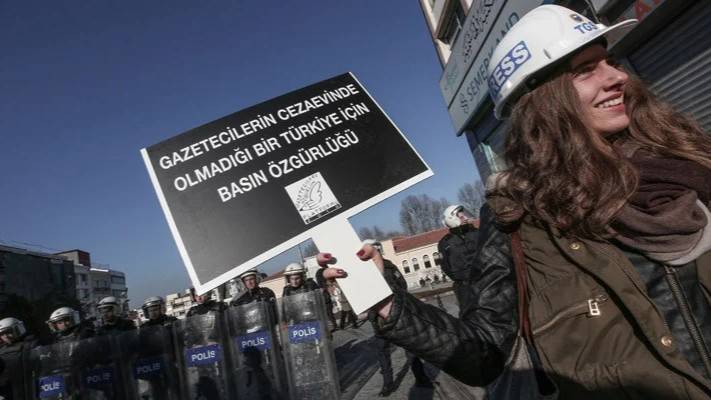
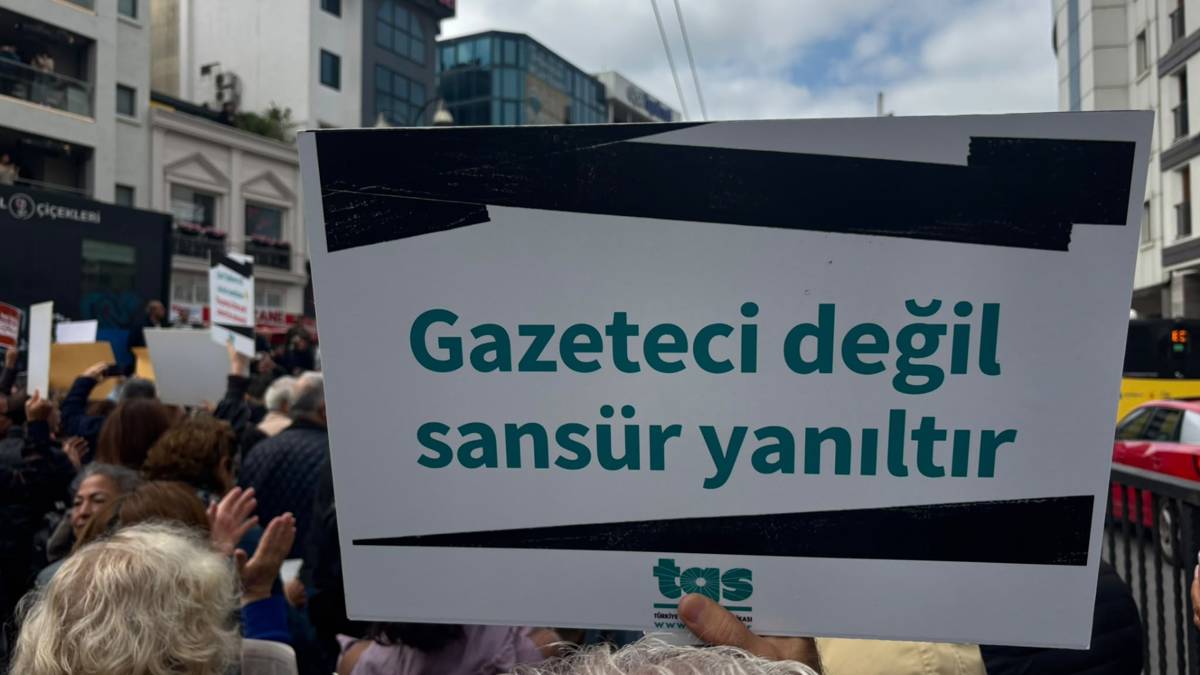
At five in the morning, the door is smashed open. If you live alone, you’re lucky. If you don’t, if you have children, a spouse, perhaps your parents or your cat, everyone is woken up in terror, and there you are, in the middle of your home life, face-to-face with the police. Dozens of officers enter every corner of your home. Because you are a journalist. This is nothing new, but in recent years journalists in Turkey have experienced it more frequently than ever. The aim is to create the impression that if a police raid takes place at the crack of dawn and a journalist is handcuffed with their hands behind their back, they must surely be guilty. In reality, there is no crime, nothing hidden or secret. A tweet you posted that evening, an article you wrote about LGBTİ+ people, or a piece of information you shared during a live broadcast is enough for those who want to conceal the truth. Because the information journalists uncover reveals who the “real criminals” are. Journalism is not a crime. Yes, just like tailoring, computer engineering, or any other profession you can think of. Does a greengrocer get detained simply for selling fruit, for example? We know that sounds absurd, but detaining journalists is every bit as absurd. I’ll be honest: I don’t like the slogan “Journalism is not a crime.” Not because it’s wrong, but because we have to keep repeating something so obvious. After every detention and every arrest, we explain that journalism is not a crime. As though we have to prove the legitimacy of practicing our profession all over again each time. Moreover, the issue is not simply that journalists lose their jobs or face prosecution because they are detained, arrested, their outlets are shut down, or trustees are appointed to media organizations. The issue also concerns which stories can be reported, which sources can speak, and which information can reach the public. In Turkey, control over all of this has long been monopolized by those in power and those who have aligned themselves with them. Mathematics is simple. There is a direct relationship between a journalist having to worry about what will happen to them while reporting a story and a citizen being unable to find out what is going on. I am writing this article to remind people why journalism is treated as though it were a crime and its cost for all of us in our lives. And, in part, to say, “Enough already. Let us do our jobs,” and “Let us talk about the other problems facing our profession.” In just the past few weeks… According to a report announced on Sunday, October 11, by Utku Çakırözer, deputy leader of the New Party, 25 journalists have been detained in the past 70 days. Ten journalists are currently in prison: Merdan Yanardağ, Selahattin Günday, Ali Tarakçı, Tuğba Tekerek, Fatih Ergin, Hasan Güraksu, İrem Delice, Şaban Sevinç, Mustafa Balcı, and Derya Okatan. Since October 11, up to October 21, the date this issue of Agos went to press, two more journalists have been added to that number: Murat Ağırel and İsmail Arı. In other words, journalists are being arrested simply for doing their jobs and informing the public about what is happening. While I am haunted by the worry that I may have missed someone, let me briefly summarize what we have been going through. On the last day of September, access to the website and social media accounts of T24, one of Turkey’s most widely read news websites, was blocked. The access restriction was imposed as part of the Istanbul Chief Public Prosecutor’s Office investigation known as “My Family Is Safe.” Before that decision, numerous LGBTİ+ activists, human rights defenders, and journalists had already been arrested in connection with the investigation, and access to individuals’ and media organizations’ digital accounts had been blocked. Meanwhile, particularly during September, access to approximately 1,300 X accounts in Turkey was blocked, including the accounts of Evrensel and Kısa Dalga. On October 9, journalists Şaban Sevinç and Mustafa Balcı, who had been detained over their commentary and reporting in connection with the so-called “funding investigation,” were arrested on charges of “publicly disseminating misleading information.” İsmail Saymaz and Murat Ağırel, who were questioned on the same charge, were released subject to judicial supervision. Following an objection by the prosecutor’s office, Saymaz and Ağırel were placed under house arrest on October 10. But Ağırel’s story was not over yet. On October 14, at 5:30 a.m., police raided Halk TV’s headquarters in Istanbul. A trustee was appointed to the channel, television broadcasts were suspended, and employees were denied entry to the building. Arrest warrants were issued for 17 people, including the channel’s owner, Cafer Mahiroğlu. Access to the channel’s social media accounts was also blocked. As part of the funding investigation, journalist Bahadır Özgür was detained on October 15 over his reporting, on a charge of “violating the confidentiality of an investigation.” He was released subject to judicial supervision, including a travel ban and a requirement to report to the authorities. Ağırel, who was already under house arrest, was taken into custody on October 19 and arrested on a charge of “aiding a criminal organization” as part of an investigation into the Sarıgül family concerning alleged “money laundering and the establishment and management of a criminal organization for profit.” On October 20, BirGün reporter İsmail Arı was detained following a complaint by former Radio and Television Supreme Council (RTÜK) chair Ebubekir Şahin. The charges were “insulting a public official on account of their duties” and “disseminating misleading information to the public.” Arı had gone to the Ankara Police Department to give a statement, where he was formally notified that he was being detained. After spending the night in custody, he was transferred to the courthouse on the morning of October 21. Following his statement to the prosecutor, he was brought before a judge with a request for his arrest. Unfortunately, as we were preparing this article for publication, we had to revise it at the last minute. İsmail Arı had been remanded in custody by the judge. In a statement sent to his newspaper, he said: “The judge didn’t even listen. They interrupted the lawyers. They are sending me back to prison once again for an offense that doesn’t even carry a prison sentence.” Arı’s words bring to mind an old saying: when the wolf has decided to eat the lamb, it no longer matters where the water flows from. Arı had previously been arrested on March 21, 2026, on a charge of “publicly disseminating misleading information.” After spending 75 days in Sincan Prison, he was released at his first hearing on June 5, without being placed under judicial supervision. Journalist Gözde Şeker, who left Halk TV some time ago, addressed viewers by quoting journalist Hilmi Hacaloğlu’s words. In her post, Şeker said: “Hilmi Hacaloğlu wrote, ‘Millions watch you in the evening, then morning comes and you are utterly alone.’ I am deeply, deeply saddened. Not only because a trustee has been appointed, but also because of this image. Where are you?” “Where are you?” Şeker’s question expresses a justified anger at the abandonment of journalists. But the issue is not just journalists’ loneliness or the pressure they face while practicing their profession. Appointing a trustee to a television channel, detaining and arresting journalists, and blocking access to news websites also constitute direct interference with the public’s right to access information. As readers, we learn through journalists about the rights being taken away from us, deepening inequalities, struggles for justice, food safety, the climate crisis, developments in culture and the arts, earthquakes and other natural disasters, LGBTİ+ rights, political prisoners, the economy, and many other developments that affect our lives. Silencing journalists means covering up these issues, making what is happening invisible, and preventing society from accessing the truth. Every act of repression against journalism takes something away from all of us. That is precisely why journalists who speak out against their colleagues being abandoned, news being censored, and the truth being obscured are also asking citizens for their support. Journalists take to the streets On Saturday, October 24, press organizations will organize nationwide protests against the repression of journalists, ranging from detentions and arrests to the appointment of trustees to media outlets and restrictions on access to news websites and social media accounts. Organizations including the Journalists’ Union of Turkey (TGS), the Journalists’ Association of Turkey, the Press Council, the Journalists’ Association, the Contemporary Journalists Association (ÇGD), the Izmir Journalists’ Association, the Dicle Fırat Journalists Association, DİSK Basın-İş, and professional associations specializing in different areas of journalism will protest the pressure on press freedom. Under a joint call to action, journalists will take to public squares at 2 p.m. on Saturday, October 24, 2026, the anniversary of the appointment of a trustee to TELE 1. The message behind the protest is clear: to oppose repression against journalists, censorship, and the practice of appointing trustees—and to defend not only journalists, but also society’s right to access information. Some time ago, I wrote for Agos about another journalist’s imprisonment, on the 100th day of journalist Furkan Karabay’s detention. I wrote: “I liken practicing journalism in Turkey to swimming in an endless, turbulent sea whose bottom cannot be seen. A sea that sometimes frightens us, one that some of us say we ‘get used to the more we venture into it,’ while others are content to watch from the shore… The presence of Furkan and others like him makes those waters far more navigable. He says, ‘Come on, let’s cross the ropes too; the sea is ours.’ Because in this country, journalism is measured not only by the pursuit of truth but also by the determination to stand up for it. It requires not only writing, but also bearing the consequences of what you write.” Let me return to that image, with the sadness of realizing that nothing has changed. Today, the sea is even rougher, the water so murky that the bottom is nowhere to be seen. But no matter how fiercely the wind blows, we need journalists who keep swimming in these waters. We also need those who wave from the shore to say, “We’re here,” those who hear our voices, and readers who will throw us a lifebuoy when necessary. Because when journalists are left alone, it is not only they who drown; society, too, loses its way to the truth. They want to darken this sea and leave us all in the dark. We have no lifebuoy other than solidarity and struggle.
Free: opens Google Translate with the text filled in. Long articles are split into numbered sections.
Premium: read the translation right here, without leaving HyeNews. Try free for 7 days.
Already in English.
Let us do our jobs
In Turkey, where journalists are detained and arrested simply for doing their jobs, news websites are blocked, and trustees are appointed to television channels, repression targets not only press freedom but also the public’s right to access information. Today, the sea is even rougher, the water so murky that the bottom is nowhere to be seen. They want to darken this sea and leave us all in the dark. We have no lifebuoy other than solidarity, struggle and doing our jobs.
Comments
No comments yet — be the first to comment.
More from Agos
Related coverage
No related coverage from other sources yet.