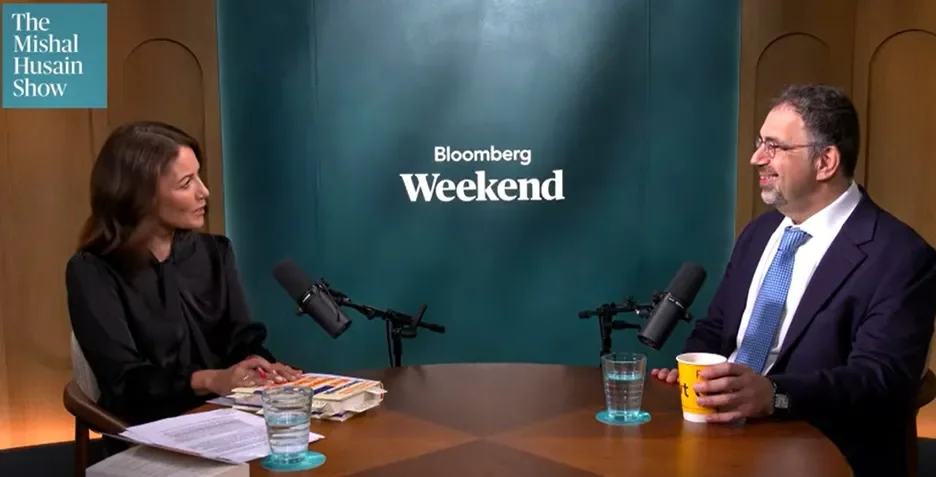
Daron Acemoglu on the Armenian Genocide, Democracy, and AI November 5, 2026 TARBERAK21 By V.T. In an interview given on October 30, 2026, for Bloomberg’s *The Mishal Husain Show*, Nobel Prize-winning economist Daron Acemoglu reflects on his childhood in Turkey, his Armenian heritage, and his family’s untold past. He also discusses the crisis of liberal democracy, economic inequality, and the growing influence of tech giants. The occasion for the interview is Acemoglu’s new book, *What Happened to Liberal Democracy: Remaking a Politics of Shared Prosperity*. However, the conversation also reveals a little-known aspect of Acemoglu’s family history: the long-standing silence surrounding the Armenian Genocide, as well as the experiences that contributed to the shaping of his academic interests. Childhood in Turkey and Armenian Identity Acemoglu grew up in Turkey and was still an adolescent when the military coup took place in 1980. He was around 13 years old at the time. The years following the coup were marked by political repression and a military presence—factors that, by his own account, had a significant impact on his youth. As a member of the Armenian minority, he also experienced the hostile attitude held by certain circles toward Armenians. He recalls that his father had left his university position. Although the family enjoyed relatively secure economic circumstances, the political climate did not leave them unaffected. In response to a question from Huseyin regarding the extent to which his Armenian identity and his experiences living in Turkey influenced his academic interests, Acemoglu explains that they played a certain role—particularly in shaping the direction of his early research. He attributes his interest in authoritarianism, democracy, economic institutions, and the consequences of political power, in part, to that period of his life. He also believes that these experiences contributed to his interest in liberal ideas—ideas that value pluralism and the coexistence of diverse perspectives. The Armenian Genocide: An Untold Family History In one of the more personal segments of the interview, Mishal Husain asks about Acemoglu’s ancestors, inquiring whether they had witnessed the tragic events of the early twentieth century. Acemoglu clarifies that he is not referring to his grandparents, but rather to the generation of their parents. When the interviewer asks whether this past was passed down as family memory, the economist explains that the answer is both yes and no. In Turkey, the Armenian Genocide was such a sensitive subject that people often did not speak about it, even within their own families. His own family was no exception. Acemoglu recounts that he had general knowledge about the Armenian Genocide and the history of the Ottoman Empire during that period. However, he was unaware of his own family’s history—specifically, how his ancestors had survived the catastrophe. This account reached him much later, when the father of one of his relatives wrote down the family’s past, and the text was subsequently passed on to him. Hüseyin asks whether it was a story of a narrow escape. Acemoglu confirms that it was, though he does not elaborate on the circumstances of the flight, nor does he specify the locations or describe the route his ancestors took. The economist notes that he had begun reading about the history of the Ottoman Empire during his late adolescence. However, he only became acquainted with the written account containing his family’s history after the age of 25. He notes that learning this history in adulthood did not have as profound an emotional impact on him as it might have had, had he heard it at the age of ten. This testimony reveals an important aspect of the transmission of historical memory: one may be aware of the history of one’s people while remaining entirely unacquainted with the experiences lived by one’s own family. In Acemoğlu’s case, the silence was linked to the social and political sensitivities surrounding the Armenian Genocide in Turkey. Yet, the family’s history was not entirely lost; it had been preserved through a written account, reaching the next generation decades later. The Crisis of Democracy: A Consequence of Economic Inequality The conversation shifts from personal life to Acemoglu’s primary scholarly and political concerns. According to the economist, the current crisis of liberal democracy cannot be explained solely by the rise of right-wing populist movements. Part of the cause must also be sought among those political forces that, for decades, have presented themselves as defenders of democracy and liberal values. Acemoglu specifically criticizes the economic priorities of center-left political forces and their gradual estrangement from the working classes. In recent decades, the transition from an industrial economy to one based on knowledge and services has not yielded the same outcomes for all segments of society. Urban populations with university education have benefited significantly from these new economic conditions, whereas many workers—particularly those without higher education—have faced stagnant incomes, job insecurity, and a weakening of their economic standing. Acemoglu points to the decline in real wages among men in the United States who lack a university education as one of the consequences of these economic shifts. He observes that, over time, this economic discontent has also evolved into political discontent. When significant segments of the citizenry feel that economic development is not improving their lives, their trust in democratic institutions weakens. Equality, Identity Politics, and the Value of Work Acemoglu’s critique also extends to certain manifestations of identity politics. This concept refers to political approaches that focus on people’s national, ethnic, religious, gender, or other identities, with the aim of protecting their rights and combating discrimination. While he supports the fight against discrimination and the necessity of social inclusion, he harbors reservations regarding the methods by which certain diversity, equality, and inclusion initiatives are implemented. In his view, when such policies are imposed from the top down—without taking into account the concerns of various segments of society—they can create new forms of conflict. The economist warns that political struggles centered on cultural issues should not relegate concerns regarding wages, working conditions, and economic justice to the background. At the core of his economic proposals lies the objective of mitigating the existing imbalance between labor and capital. Acemoglu criticizes tax systems that treat labor income and capital income differently—a structure that sometimes makes it more profitable for companies to replace human labor with machinery. He advocates for a revision of the tax system that would reduce this inequality and create a fairer basis for state revenue. However, he emphasizes that economic policy cannot succeed through tax reforms alone. Democratic societies must also rediscover a sense of social justice, mutual obligation, and collective well-being. Artificial Intelligence: In What Direction Is Development Heading? One of the key parts of the interview concerns the development of artificial intelligence (AI) and its economic consequences. Acemoglu warns that the great enthusiasm surrounding AI should not be confused with the actual impact it has already had on the economy. Although AI-based conversational systems have become widespread, their integration into production and work processes remains limited—with the exception of certain sectors, such as computer programming. However, his primary concern lies in the current trajectory of AI development. Acemoglu criticizes the tendency among major technology companies to prioritize the creation of general-purpose artificial intelligence that either matches or surpasses human capabilities. In his view, this objective absorbs vast amounts of capital and scientific potential—resources that could otherwise be directed toward developing tools that enhance workers’ abilities, boost productivity, and address the genuine needs of society. Under this approach, technological progress should not be measured solely by the capabilities of machines or their potential to replace human labor. It is equally important to consider the extent to which new technologies contribute to workers’ productivity, economic well-being, and social participation. In other words, for Acemoglu, the fundamental question is not merely how much AI will develop, but rather whom that development will serve. Tech Giants and Democratic Oversight Acemoglu also expresses concern regarding the growing social and political influence wielded by the leaders of major technology companies. He criticizes the tendency to treat statements by Elon Musk, Sam Altman, and other tech entrepreneurs as authoritative guides for the future of society. In his view, the media should approach the ideas and promises of these entrepreneurs with greater critical scrutiny, rather than granting them a privileged position to steer public discourse. The economist’s concern goes beyond the influence of individual leaders. The issue is also that the technological decisions shaping the future of society are increasingly concentrated in the hands of a limited number of companies—without adequate democratic oversight. This concern extends to social media platforms as well. Acemoglu criticizes their algorithmic systems, which prioritize content that captures and sustains users’ attention while eliciting strong reactions. He advocates for limiting—or even banning—the operation of such recommendation systems. His proposal is not directed against freedom of speech, but rather against the practices through which social media platforms disseminate certain types of content—practices that can exacerbate societal polarization. Following the same logic, he advocates for measures to limit the influence of money on politics, including a proposal to ban political spending by corporations. According to Acemoglu, the concentration of economic power, control over the information environment, and the influence of money on political decision-making are interconnected issues that can weaken democratic engagement. The Future of Democracy: In the Hands of Society The various parts of the interview converge around a central idea: democracy cannot remain healthy if economic and political power continues to be concentrated in the hands of a small number of influential individuals and institutions. For Acemoglu, the restoration of democracy is not limited to elections or a change in political leadership. It requires a re-evaluation of the goals of economic development, the value of labor, the direction of technological innovation, and the participation of citizens in public decision-making. The alternative he proposes involves strengthening economic justice, social cohesion, and democratic participation. From this perspective, a notable connection can be observed between Acemoglu’s personal history and his scholarly concerns. The experience of an Armenian youth growing up in Turkey—amidst political pressures and the silence within families regarding the Armenian Genocide—illustrates the diverse realities of a society where the conditions of power can affect not only people’s daily lives but also their capacity to speak and pass on their own history. The economist’s subsequent research focuses on a broader, more comprehensive question: how can institutions be created that limit the concentration of power and provide citizens with a genuine opportunity to participate in shaping the future of their society? Consequently, the central issue arising from Acemoglu’s interview concerns not merely democracy or artificial intelligence, but the right to determine the future of society. Will economic and technological progress serve society as a whole, or will it continue to concentrate wealth and power in the hands of a limited number of people? According to the approach presented by Acemoglu, the answer to this question should not be left solely to political leaders, the economic elite, or tech giants.
Free: opens Google Translate with the text filled in. Long articles are split into numbered sections.
Premium: read the translation right here, without leaving HyeNews. Try free for 7 days.
Already in English.
Daron Acemoglu on the Armenian Genocide, Democracy, and AI
TARBERAK21 By V.T. In an interview given on October 30, 2026, for Bloomberg’s *The Mishal Husain Show*, Nobel Prize-winning economist Daron Acemoglu reflects on his childhood in Turkey, his Armenian heritage, and his family’s...
Comments
No comments yet — be the first to comment.
More from The California Courier
LOST BUT NOT FORGOTTEN
The California Courier / 8 hours ago
A Tale of Two Hearths: How History Severed and Shaped the Armenian Palate
The California Courier / 8 hours ago
Turkey Uses AI and Other Tech to Claw Back 100 Looted Antiquities from the US
The California Courier / 8 hours ago

Traffic Nightmare in Yerevan
The California Courier / 8 hours ago
Related coverage
A Lifetime Of Scholarship, Now Open To The World
MassisPost / Nov 4

How the Genealogy Conference can help families recover stories lost during the Genocide
The Armenian Weekly / Nov 4

Review of Perla Kantarjian’s “You Must Become Field”
The Armenian Weekly / Nov 4

Opening Of The “Steve Artinian” Hall At The ARF Hollywood “Karekin Njdeh” Community Center
Western Prelacy of the Armenian Apostolic Church / Oct 30