Every time a political strongman is ousted, shockwaves are sent throughout Georgia’s besieged democratic society. This year, voters ousted Hungarian Prime Minister Viktor Orbán in April and Serbian President Aleksandar Vučić in October. In both cases, there were two local reactions: the optimism that such a thing could be accomplished and reflection on why it has so far failed to happen. This latter act of soul-searching, however, often gets lost in comparisons and usually deteriorates into assigning blame, producing no constructive results. Comparisons today often address questions of regime type, social structure, and electoral strategies without differentiation or subtlety. They fail because they stop being inquiries directed at learning and become part of internal political struggles. This certainly does not mean these cases offer no useful guidance. Still, picking the proper approach is essential for learning anything. Patronal politics and the case for (limited) comparison As a comparativist, I have referred to the Serbian and Hungarian cases as relevant examples for Georgia before, while being attentive to context and nuance. Over the last decade, elected or popularly endorsed strongmen dominated all three countries. The Georgian case was complicated by the fact that the strongman was in office formally only briefly — Georgian Dream founder and billionaire Bidzina Ivanishvili has generally held informal power through the patronal hierarchy and controlled the captured state from an unofficial position. In comparison, Vučić and Orbán controlled the captured state by serving at the highest political offices and directing an informal patronage pyramid. Georgian and Serbian officials celebrate ‘common features’ The Georgian delegation’s visit comes after the Serbian Parliament officially approved the resignation of Prime Minister Miloš Vučević on 19 March. OC Media OC Media Patronalism is an enduring social and political arrangement — it is broader than merely corruption. In today’s social context, it is a voluntary setup where the ‘chief patron’ gains access to resources by holding power or influence within the state apparatus. He then distributes other official positions and said resources to his ‘clients’, who become more dependent the lower one descends the pyramid. At the lowest level, we have clients reliant on the regime for their daily survival via unstable jobs and social benefits that the regime can revoke at will. This dependency chain produces votes for the chief patron’s endorsement in each successive election. To remove the chief patron, a significant number of clients must rally together, yet the hardest to mobilise are those who are the most dependent, and they seldom take action. It is only the less reliant clients in the middle and upper tiers of the patronal pyramid who can remove the leader and possibly dismantle the whole pyramid. It is this system that keeps the comparison between the three countries relevant, even as Georgia’s political regime continues to drift further from a democracy. Indeed, it would be misleading to describe Georgia’s authoritarianism as anything resembling ‘competitive’. After all, when every opposition party that passed the electoral threshold in the last competitive elections is threatened with bans , discussing ‘competitiveness’ becomes highly offensive. Neither Orbán nor Vučić has ever been as repressive as Ivanishvili. While Orbán required over 10 years to incarcerate one political opponent, Ivanishvili used legal abuses to push political rivals out of the political arena as early as 2014. Although the Serbian regime employed severe protest management methods, it did not match the brutality of the Georgian regime. The latter indiscriminately used rubber bullets and highly toxic chemical agents , leading to protesters losing their eyesight and experiencing lasting health damage. Hungarian and Serbian protesters were not subjected to torture in police minibuses or charged en masse with petty hooliganism. In the end, Orbán and Vučić did not use mass repression to maintain power, although Vučić apparently considered it , and they accepted losing popular support and handed over power peacefully. ‘When we get in the minibus, the fun will start’ — How Georgian police torture detained protesters Demonstrators detained by police during the protests in Tbilisi have noted a systemic pattern of police brutality. OC Media Mariam Bogveradze In 2024, Georgia ceased to be a democracy, and its patronalism persists and is now more deeply rooted than before, with Georgian society evidently embracing it. This is the point at which the paths of Georgia and Serbia (or Hungary) diverged dramatically. The role of the opposition’s organisation and the Serbian puzzle People express their frustration with patronal politics differently. Commonly, the leader becomes the scapegoat for the system’s faults upon his ouster. The new leader runs on the anti-system programme, often promising to replace it. However, once positioned at the pyramid’s peak, the rules of that pyramid commonly hold sway. Although the patron’s loss in the election seems like a triumph for democracy, the excitement of winning often overshadows the fact that removing the leader does not necessarily liberalise the patronal system. When the first burst of enthusiasm dies down, liberals encounter multiple disappointments. Winning requires the new leaders or dominant political forces to build a broad alliance that includes many illiberal elements. Although the winners may not be illiberal in themselves, during governing, they realise that maintaining old patronal practices and superficial restructuring frequently appear to be the most economical and least risky alternatives to comprehensive reform. It is important here to look at the differences between Vučić’s ouster and Orbán’s. In the latter, Prime Minister Péter Magyar created a disciplined and broad political campaign machine and used his charisma to oust the Hungarian strongman. He might fulfil his promise and dismantle the Orbán political regime, yet he might also become trapped in the very same system. Hungary’s Magyar says he wants to continue ‘good relations with Georgia’ At the same time, Péter Magyar emphasised that Hungary has ‘no intention of interfering in the internal affairs of other countries’. OC Media OC Media Serbia offers a puzzle here. Vučić was not defeated by a charismatic rival — Serbian students offered no such leader. Rather than working from the top down, Serbian students launched their own grassroots movement, characterised by decentralisation and a bottom-up approach. Such mobilisation, though temporary because of the absence of an organisational framework, remains highly effective and largely escapes regime targeting. Does the Serbian students’ win without a credible leader suggest a stronger rejection of the patronalist system? Serbian political scientist Dušan Pavlović makes the case for this optimistic reading: ‘For them [the students], Vučić was culturally obsolete. He represented a political world with which they no longer wanted to identify: patronage, clientelism, corruption, informal deals, and a system in which personal connections and political loyalty mattered more than education, competence, or merit […] This attitude gradually spread beyond their generation. Older voters who had long grown dissatisfied with Vučić, but had repeatedly failed to find a credible alternative, began to identify with the students’ rejection of his political culture’. It remains to be seen if this profound societal change has truly happened in Serbia and if it will lead to the end of patronal politics. Still, both Serbs and Hungarians opposed the faults of the patronal system and showed that their apparent support for it was actually a falsified preference. The regime as a mirror image Patronal politics is a mirror image of patronalist society. It crumbles when citizens can no longer tolerate their own reflection. Looking in the mirror, Hungarians and Serbs took action to alter what they observed. In 2024, the regime compelled Georgians to look in the mirror, yet the reflection disgusted only a slight relative majority of them. The official turnout of Hungarian elections was 78%, while in Serbia, turnout was 69%. The voter turnout in Georgia’s 2024 parliamentary elections was just 60%. In Georgia, a large segment of the electorate with the power to reject the regime at the polls failed to take action. Their passive acceptance of the regime is still an endorsement, regardless of how they justify their inaction. The intellectual arguments for rebelling against both the corrupt regime and the corrupt opposition cannot disguise their true preference for maintaining the status quo. Opinion | ‘A list of rich people in a poor country’ — what Forbes’ top 100 list reveals about Georgia Georgia’s Forbes Top 100 shows an uneven playing field, offshore wealth, hidden names, and women playing safety rings for rich families. OC Media Helena Bedwell During spring and summer 2024, Bidzina Ivanishvili clearly expressed, with his own unique frankness, his aim to construct a dictatorship. He presented the choice out in the open, and no ‘intellectualisations’ can justify the silence of the masses. There is always a choice. Despite not having a credible alternative leader, Serbs boldly challenged the system. They removed Vučić even though he maintained a stable economic performance. Hungarian voters proved that one can avoid being fooled by propaganda, despite Orbán running a war scare campaign as fierce as that of Georgia’s regime. In comparison, both active and passive supporters of Georgia’s regime have opted for the comfort provided by Russian and other illicit funds: parallel trade with Russia to evade sanctions, fraudulent call centres, crypto scams, and the regime’s other criminal ventures alongside looted public resources. Neither Serbs nor Hungarians chose angels to lead them into a liberal paradise. Those Georgians who justify their passive support of the regime by rebelling against the discredited and disorganised opposition will scoff at this point. They will say, ‘Look, imperfect alternatives did not deceive us!’. While soothing their conscience with excuses, they ignore that politics does not simply boil down to choosing between the hell of tyranny and the paradise of a liberal society. Georgia’s opposition, by genuinely appearing cleaner, more credible, and more organised, could definitely prevent the ‘silent rebels’ from using this excuse. Those in democratic civil society and the public who willingly opted for democracy might have avoided being so smug, self-righteous, and indulgent in the regime’s social polarisation tactics (I also hold myself accountable for this and confess my own errors). If they had been more open, inclusive, and pragmatic like Serbian students, and less strict about the compromises required in democratic politics, they could have formed a wider anti-regime coalition with social groups that opposed the regime despite not sharing the liberal agenda. Though we Georgians couldn’t see ourselves clearly in our own mirror, Serbia and Hungary offer useful reflections too. Using this mirror correctly means not fixating on everyone else’s flaws and neglecting one’s own. Using this exercise to assign blame or dwell on past guilt is ineffective and ultimately detrimental. The correct course is to accept responsibility in the present and behave accordingly for what lies ahead of us. The path out of dictatorship is thorny; the game has changed, and it is no longer the competitive elections where strongmen can lose. Reclaiming competitive elections takes more than just a vote. When people challenge the pyramid of power, patronal dictatorships also fall apart. Georgia’s dictatorship will end once the majority of its citizens recognise themselves in it and, by dismantling it, also remake their identity.
Free: opens Google Translate with the text filled in. Long articles are split into numbered sections.
Premium: read the translation right here, without leaving HyeNews. Try free for 7 days.
Already in English.
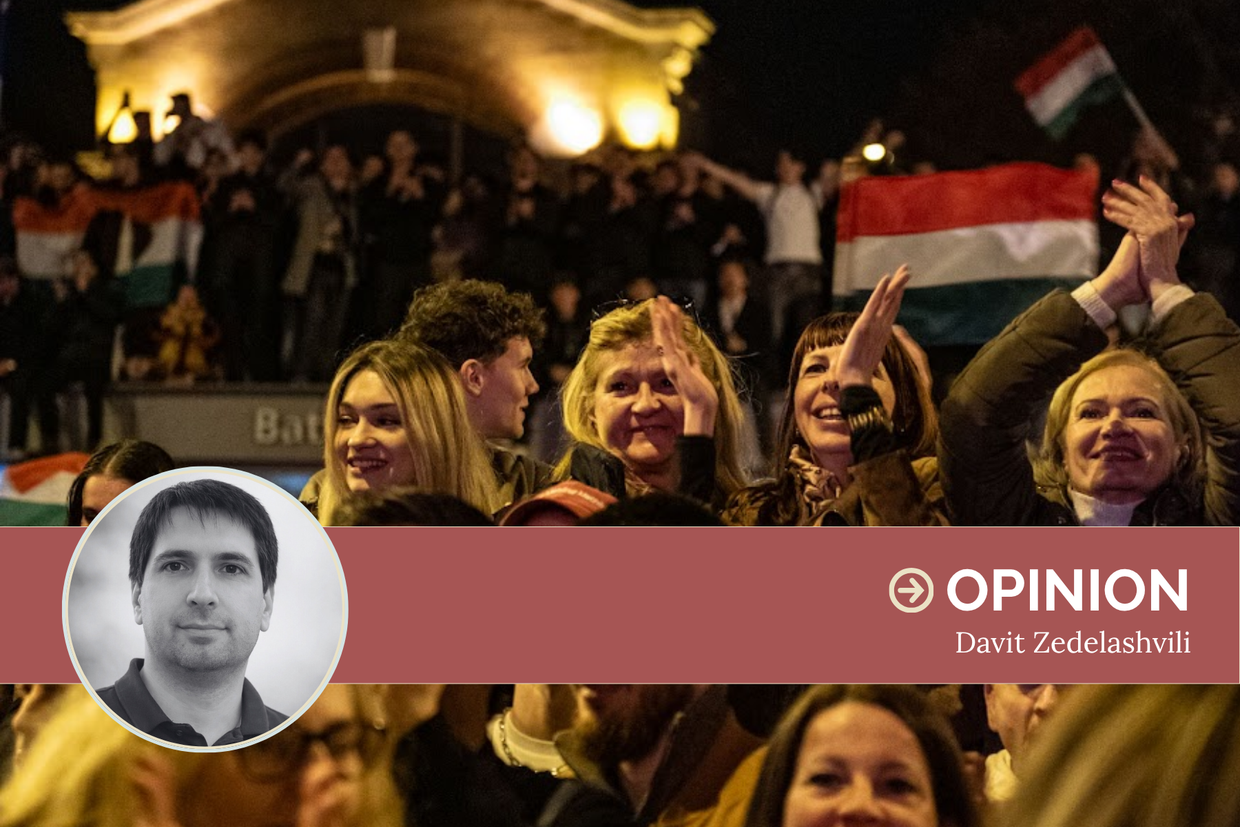
Opinion | Can Serbia and Hungary offer a mirror to Georgians?
Amidst dictatorship, the victory of Hungarian voters and Serbian students resonates in Georgia.
Comments
No comments yet — be the first to comment.
More from OC Media

Podcast | Will the Blue Tsunami reach the Caucasus?
OC Media / 26 minutes ago
Explainer | What could the US midterms mean for the Caucasus
OC Media / 38 minutes ago
Review | National Exams — finding hope for the future among Georgia’s youth
OC Media / 1 hour ago
NGOs sound alarm as Georgia’s government makes challenging election results harder
OC Media / 1 hour ago
Related coverage

ՈւՂԻՂ. Շարունակվում է հակասահմանադրական ճանաչված հոդվածով մեղադրանքի դատական նիստը
News.am / 1 hour ago

«Հայէկոնոմբանկ»-ն արձագանքում է Մհեր Արմենիայի մեղադրանքներին․«բազմիցս հնարավորություն է տրվել կատարել ստանձնած պարտավորությունները և կարգավորել խնդիրը»
Factor.am / 1 hour ago
Заторы — проблема не только Еревана, но и Токио, и Нью-Йорка: мнение эксперта из России
Sputnik Armenia / 1 hour ago

«Ո՛չ կարծիք ունեմ, ո՛չ էլ՝ մեկնաբանություն». Միրզոյանը՝ ՀԱՊԿ-ում ՀՀ-ի հարցի քննարկման մասին
Yerkir / 2 hours ago