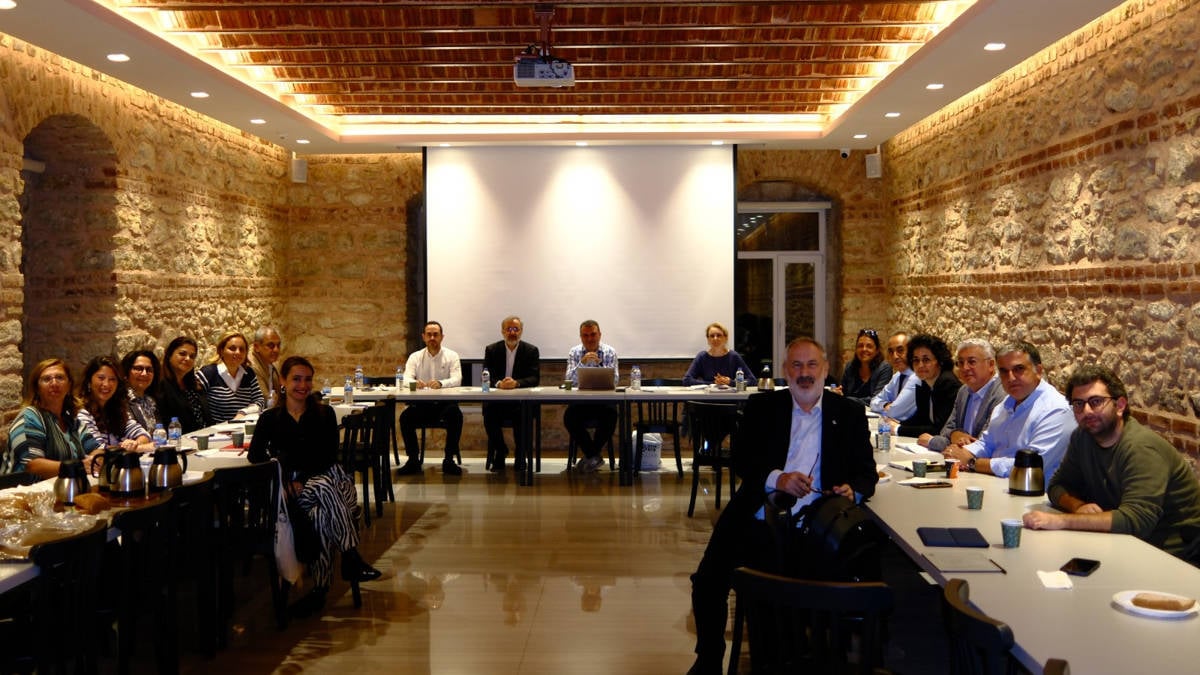
The meeting took place on Monday, October 12, in the Gomidas Hall of Yedikule Surp Pırgiç Hospital. Participants included Senior Father Drtad Uzunyan and Nora Şenyan, who prepared the Religious Studies curriculum, as well as the coordinating principals responsible for the Armenian language course curriculum, teachers, and the general coordinator of the curriculum working group. The main agenda item was the progress made on the Armenian language course and Religious Culture and Ethics curricula, which are being developed under the Ministry of National Education’s “Century of Turkish Education Model” ( Türkiye Yüzyılı Maarif Modeli ). According to a statement the Education Commission released to the press following the meeting, the Religious Studies curriculum has been submitted to the Ministry of National Education’s Board of Education and Discipline. The curriculum is awaiting the Board’s approval. The working group for the Armenian language course curriculum also provided an update on its progress. At the meeting, it was decided that the ERVAB Education Commission would prepare an additional budget for curriculum development and submit it to ERVAB, so that the foundations could contribute in accordance with their financial circumstances. Speaking to Agos, ERVAB Education Commission Chair Mari Yancı said that preparations for educational materials would begin once the Religious Studies curriculum had been approved. Yancı added that revisions to the Armenian language course curriculum are still underway and that they expect it to be approved during the 2026–2027 academic year. Curriculum development process Century of Turkish Education Model was introduced in the 2024–2025 academic year. As part of the model, Armenian schools were asked to develop a new curriculum for Armenian-language instruction. The Armenian Language Curriculum Working Group, established under the ERVAB Education Commission, began its work on August 20, 2025. Seventeen teachers are working on developing curricula for primary, middle, and high school levels. Professor Mustafa Öztürk has been appointed technical project manager. The work focuses on two main objectives. The first is to ensure that Armenian language classes taught in schools follow the same standards, eliminate differences in proficiency levels between schools, and provide systematic, grade-specific lesson content for both currently employed teachers and those entering the profession. The second objective is to find a solution to the problem that prevents Armenian language courses from being graded in the Ministry of National Education’s e-School system. If the curriculum is approved, the existing problem that prevents report-card grades from being issued for the first and second grade pupils in primary schools will be resolved. Schools will also be able to follow a single, unified resource. Under the Model, the Ministry bases its curricula for Turkish and other language courses on the CEFR (Common European Framework of Reference for Languages). Rather than relying on rote memorization, this framework aims to enable communication through language. Accordingly, the curricula for language courses incorporate four skills: reading, listening, speaking, and writing.
Translate this article
Free: opens Google Translate with the text filled in. Long articles are split into numbered sections.
Premium: read the translation right here, without leaving HyeNews. Try free for 7 days.
Already in English.
Church & Religion
Religious studies curriculum submitted to the Board of Education
The Education Commission of the Union of Armenian Foundations (ERVAB) held its regular monthly meeting. The meeting addressed progress on the Armenian language and Religious Culture and Ethics curricula requested by the Ministry of National Education. According to the commission’s statement, the Religious Studies curriculum has been submitted to the Board of Education and Discipline. Revisions to the Armenian language course curriculum are ongoing.
Comments
Sign in to join the conversation.
No comments yet — be the first to comment.
More from Agos

Related coverage
No related coverage from other sources yet.