Yuki Kusakabe is a Tokyo-based alto saxophonist who combines a real estate career with an active life in jazz. He picked up the saxophone at age nine, played in university big bands alongside renowned musicians such as Dick Oatts and Eric Marienthal, and now performs with Bell Peppers, a Tokyo band led by Keisuke Arii.
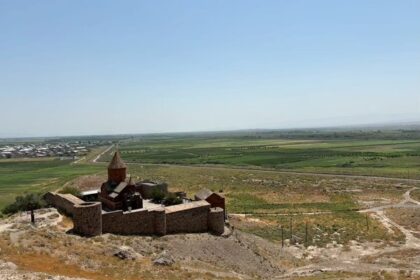
Khor Virap Monastery stands on its hill above the Ararat plain. Photo courtesy of Yuki Kusakabe.
His road to Armenia began with music. Years of listening to the Gyumri-born pianist Tigran Hamasyan made him curious about the country behind the sound, and in the summer of 2025 he traveled there, visiting Yerevan, Khor Virap, Geghard, Garni and Gyumri. Khor Virap, the monastery facing Mount Ararat where St. Gregory the Illuminator is believed to have been imprisoned, moved him most. The visit became the inspiration for “Khor Virap”, his composition on the Bell Peppers EP Cosmic Spice.
In this interview with Azad-Hye, Kusakabe talks about the kindness he met as a solo traveler, the sound of the duduk, the parallels he sees between Mount Ararat and Mount Fuji, and why he believes music can help Armenians and Japanese people discover each other.
1. Could you briefly introduce yourself to our readers? Tell us about your professional life, your musical activities with Bell Peppers, and how music became an important part of your life.
I work for a real estate company in Japan, and I’m also a jazz musician.
One of my earliest musical influences came from my mother, who often listened to John Coltrane’s Ballads. That helped inspire me to take up the alto saxophone at nine.
I played in school concert bands throughout junior high and high school. In college, I performed with big bands including Rikkyo University’s New Swingin’ Herd and Keio University’s Light Music Society. Through those groups, I had the chance to share the stage with renowned musicians such as Dick Oatts, Eric Marienthal, and Jonathan Powell. Playing alongside musicians of that caliber taught me a great deal about jazz.
After college, I began working in real estate but continued performing at jazz clubs, playing on recording sessions, and taking part in other musical projects.
Bell Peppers is one of the bands I play with today. Most of the members have day jobs in fields ranging from IT and architecture to real estate, while continuing to make music together.
Led by our leader, Keisuke Arii, we aim for an inviting groove punctuated by unexpected turns—little bits of “spice” that catch the ear. We want our music to blend naturally into everyday life while still making people stop and listen. Most of our repertoire consists of original pieces by band members, with influences ranging from contemporary jazz to progressive rock.
Our EP Cosmic Spice, which includes my piece “Khor Virap”, captures that approach. The record moves through five distinct worlds: Keisuke Arii’s “Fractal”, which explores the relationship between geometry and life; “Travail”, by Takayuki Shiba and Arii, about finding the strength to move forward after a journey; Arii’s “Paprika Odyssey”, which imagines a voyage through space; Jumpei Kobayashi’s “Blackened Gems”, inspired by the beauty and mystique of gemstones; and my own “Khor Virap”, inspired by Armenia’s landscape and religious history. Taken together, the EP feels like a journey through places and emotions just beyond the everyday.
Music has never been just a hobby for me. I wasn’t a particularly confident child or someone who naturally stood out. Once I started playing saxophone, however, I learned that the more I practiced, the more I improved. Music was one of the first things to give me real confidence in myself.
Through music, I’ve met some of the most important people in my life, including the members of Bell Peppers and many of my closest friends. It has been there for me through difficult and painful times, not just the good ones. For me, music is a way to express myself, connect with others, and find my way through life.
Yuki Kusakabe with fellow musicians of Bell Peppers in Tokyo. Photo courtesy of Yuki Kusakabe.
2. Armenia is not yet a common tourist destination for Japanese travelers. What made you decide to visit?
My introduction to Armenia came through Tigran Hamasyan, the internationally renowned jazz pianist from Gyumri in the Shirak region. What fascinated me was the way he blends jazz, traditional Armenian music, and other influences into a sound entirely his own.
I had been listening to his album Shadow Theater for years when I began to wonder, “What kind of place and culture lead to the creation of music like this?”
That question led me to learn about his background, and my curiosity grew from there. I began reading about traditional Armenian music, then the country’s history, architecture, religion, and food. The more I learned, the more I wanted to experience Armenia for myself.
Christian history was another reason I was drawn to Armenia. I attended Christian schools and had long been interested in Christian history and culture. Learning that Armenia was the first country to adopt Christianity as its state religion immediately caught my attention.
Music was the doorway, but it opened onto much more. Eventually, reading about Armenia was no longer enough—I wanted to go.
3. During your visit, what were your first impressions of Armenia and its people? Was there anything that surprised you or exceeded your expectations?
I traveled to Armenia in the summer of 2025 and visited Yerevan, Khor Virap, Geghard, Garni, and Gyumri.
There were many things that left an impression on me, but two stood out in particular: the kindness of locals, and the way history and tradition seemed to coexist naturally with everyday life. I don’t speak Armenian, so communication was sometimes difficult. Even so, people found ways to help me—through English, gestures, or simply taking the time to figure things out together.
At one point, my phone stopped connecting to the mobile network, and a local helped me adjust my Ucom settings until it was working again. At Geghard Monastery, my taxi driver bought some “Gata”, a traditional Armenian pastry, for us to share. There were many moments like that throughout the trip.
When you’re traveling alone in a country where you don’t speak the language, small acts of kindness can completely change how safe and welcome you feel. Those experiences also made me reflect on how I want to engage with visitors to Japan in the future.
The other thing that stood out to me was Armenia’s sense of historical continuity. The ancient and medieval past does not feel remote; you encounter it in churches, architecture, food, and daily life.
One seemingly ordinary example I remember vividly is Armenia’s “Pulpulaks”—the public drinking fountains found throughout the country. During the trip, I learned that they are part of a much older Armenian tradition of communal water sources. I often saw people stop for a drink as they went about their day, and I found it fascinating to see something with such deep cultural roots still so naturally woven into everyday life.
Yuki Kusakabe in the historic center of Gyumri, a city whose old architecture remains part of its identity today. Photo courtesy of Yuki Kusakabe.
I’ve always been interested in architecture and cityscapes, so I tend to pay close attention to the streets and buildings when I travel. Tokyo (the capital of Japan, and the city I live in) is going through a major wave of change, with older buildings being torn down and replaced by new high-rises, gradually reshaping the cityscape. There are clear benefits, including greater convenience and stronger disaster resilience, but I sometimes feel a sense of loss when buildings with history and character, long-standing local shops and restaurants, and the distinctive character of neighborhoods disappear.
What struck me in Armenia was the contrast. In the places I visited, historic architecture and local culture did not seem separate from contemporary life, but remained very much a part of it. Gyumri made a particularly strong impression on me: much of its historic architecture remains, not simply as something preserved from the past, but as part of what continues to shape the city’s identity today.
I was there only briefly and can speak only from one traveler’s perspective. Still, the trip stayed with me in ways I hadn’t expected, and it also changed the way I thought about contemporary Japan.
4. Among all the places you visited, why did Khor Virap leave such a profound impression on you? Was it the scenery, the history, or the spirituality of the place?
Khor Virap was a place where I felt a powerful connection to the history of Christianity, which has long been part of my background and a subject of deep interest to me. The sight of Khor Virap standing on its hill, with Mount Ararat rising majestically behind it, has a beauty that feels deeply sacred, but the history and spiritual weight of the place affected me even more. Christianity is now a global faith, but its path to becoming one was long and complex, marked by persecution and tragedy before later periods of extraordinary growth, flourishing, and cultural influence. The fact that Christianity can feel so familiar and close to someone like me today is the result of generations of people living through that history, preserving their faith and traditions, and passing them on to those who came after them.
Against that broader history of persecution, endurance, and continuity, the story of St. Gregory the Illuminator took on a much deeper significance for me. According to the traditional account, Gregory was imprisoned underground for thirteen years during the persecution of Christians under King Tiridates III. Tiridates later converted, and Armenia became the first nation to adopt Christianity as its state religion. The reversal feels almost miraculous: a persecuted prisoner became central to a transformation in the religious history of an entire country.
When I visited Khor Virap, I climbed down into the underground chamber where St. Gregory is believed to have been confined for thirteen years. It’s a cra
mped space, and people kept coming down the ladder from above. For a while, I couldn’t find a chance to climb back out, and I remember feeling genuinely anxious.
For those few minutes, my thoughts turned to the years St. Gregory is said to have spent there. What I experienced was, of course, nothing remotely comparable, but being inside the chamber made the story feel physically more immediate to me.
Yuki Kusakabe at Khor Virap, overlooking the Ararat plain. Photo courtesy of Yuki Kusakabe.
When I climbed back out and later stood on a hill facing Mount Ararat, I was overcome by a completely different feeling. In that vast landscape, I had an almost mystical sense that the boundary between me and everything around me had briefly disappeared—that I had become part of the landscape itself.
To me, Khor Virap was far more than a monastery with a beautiful view of Mount Ararat. Everything I experienced there—the place, its history, and the feelings it stirred in me—made it unlike anywhere else I visited in Armenia.
5. Many visitors describe Armenia as a country where history, faith, and nature coexist in a unique way. Did your journey leave you with any personal or spiritual impressions that stayed with you after you returned to Japan?
I’ve traveled to 34 countries, and Armenia remains one of the places I’ve felt most connected to. Something about it just clicked with me—the food, the people, the climate, and the atmosphere of the cities. The country remained in my thoughts long after I came home.
Among those memories, one particular sound has stayed especially vivid: the tone of the “Duduk”. Near the parking lot at Geghard Monastery, I came across a group of musicians playing traditional Armenian music. There was a gentle melancholy in its sound, along with an incredible beauty. It seemed to carry the weight of Armenia’s long history.
As a musician myself, I was deeply moved by the distinctive tone of the duduk and by traditional Armenian music. After returning to Japan, I began seeking out more Armenian music online and dug deeper once I started composing “Khor Virap.” The trip ended, but it felt as though music gave me a way to keep that connection alive.
I also came home convinced that Armenia is not a country you can truly get to know in a single visit. I couldn’t make it to places like Lake Sevan or Etchmiadzin Cathedral; many historic sites, sacred places, and natural landscapes remain for me to discover.
If I have the chance to return, I hope to go beyond sightseeing—to experience more of the country through its music, food, and everyday life, and to get to know Armenian culture more deeply.
6. Music often becomes a bridge between cultures without the need for translation. Do you think jazz—or music more broadly—can help Armenians and Japanese people better understand one another and build friendships, even though the two cultures may still know relatively little about each other?
Yes, I believe it can.
In fact, it was Tigran Hamasyan’s music that first sparked my interest in Armenia.
Some musicians, like him, incorporate the traditional music and culture of the places where they grew up into their own work. There are also many musicians who turn the impressions they receive from places they have traveled into music. I myself find great value in visiting a different cultural environment, experiencing its landscapes, people, history, and atmosphere firsthand, and expressing what I felt there through music.
One album I often think about in this context is the Dave Brubeck Quartet’s 1964 record Jazz Impressions of Japan. Brubeck wrote it after visiting Japan, and it can be regarded as a kind of musical travel diary.
In the liner notes, Brubeck himself acknowledges that a brief visit could never allow him to understand everything about a place that was unfamiliar to him. Instead, he explains that he tried to express through music the small but lasting impressions left by the sights and sounds he encountered during his journey. I think this is an important way of approaching music inspired by another culture.
As a Japanese listener, I hear elements—such as certain sounds intended to evoke something “Oriental”—that don’t sound particularly Japanese to my ears.
But I do not simply regard those elements as “wrong.”
The album is not an objective explanation of “Japan itself.” It is an expression of the Japan that one American musician, Dave Brubeck, saw, heard, and experienced during his visit.
That is what makes the record so interesting to me. It raises questions: Why did Japan look like this to Brubeck? What kind of place did Japan appear to be to an American visitor at that time? I imagine many Japanese listeners, whether their response to the album is positive or critical, might find themselves asking similar questions. I believe that simply asking those questions is already a first step toward understanding another culture.
The same idea applies to my composition “Khor Virap”. I’m certainly not an expert on Armenian culture, and I would never claim that one trip gave me a complete understanding of Armenia. The piece isn’t an attempt to make “Armenian music.” It is my musical response, as someone born and raised in Japan, to standing at Khor Virap and encountering its landscape, history, and religious significance.
If an Armenian listener hears the piece and wonders, even briefly, “Why did this Japanese musician see our country this way?”, I would be very happy. I would be equally happy if someone in Japan heard it and started to wonder, “What is Khor Virap?” or “I wonder what Armenia is like?”
I do not think mutual understanding between cultures necessarily requires fully understanding another culture from the outset. Often, it begins with curiosity: Why does this person see the world this way? Why did this place affect them so deeply? Music is extraordinarily good at prompting those first questions.
That is why I believe music can become a meaningful bridge between geographically and culturally distant countries such as Armenia and Japan. Through music, people can learn about one another, deepen their understanding, and ultimately build friendship.
A pulpulak, one of Armenia’s public drinking fountains, in central Yerevan. Kusakabe was struck by how this old tradition of communal water sources remains part of everyday life. Photo courtesy of Yuki Kusakabe.
7. Japan and Armenia are geographically distant but share certain cultural values, such as respect for history and tradition. During your visit, did you notice any similarities between the two cultures?
One similarity I noticed was in certain aspects of national and cultural identity—especially how deeply people value history, tradition, and shared symbols.
The roles of Mt. Ararat and Mt. Fuji in their respective cultures illustrate this well. The attachment that many Armenians are said to feel toward Mt. Ararat, and the history behind it, reminded me of the special meaning Mt. Fuji has for many Japanese people.
Mt. Ararat is associated with the story of Noah’s Ark, while Mt. Fuji has long been the subject of myths and religious traditions of its own. Both mountains also have a beautiful, distinctive conical shape, and both have appeared again and again in paintings, literature, and other forms of art.
I think many Japanese people can relate to this feeling: when you spot Mt. Fuji in the distance, simply seeing it somehow makes you a little happy. While I was in Armenia, I had the sense that Mt. Ararat might hold a similar place in the hearts of the Armenians. That also made me feel that Japanese and Armenian people have much in common in the way they value history and tradition and feel connected to their own culture and community—something that, as I mentioned earlier, seemed to be reflected in the warmth Armenian people showed me as a visitor from abroad.
Another similarity I noticed was that both countries have experienced major disasters and rebuilt from them. I’m embarrassed to admit that before visiting Armenia, I didn’t know about the devastating 1988 earthquake or how severely it affected Gyumri and other parts of the country.
Japan, too, has experienced numerous major earthquakes and tsunamis in its history, including the Great East Japan Earthquake in 2011.
Armenia and Japan differ greatly in geography and climate, but I felt something deeply familiar in how communities respond to major disasters: even as they rebuild and restore daily life, they continue to make a deliberate effort to preserve their traditional culture and architecture for future generations. In Gyumri, I saw exhibits documenting the rebuilding process, and saw buildings that still carry visible traces of the earthquake. As someone from Japan, I felt a strong connection to what I was seeing. At the same time, Armenia, which had once seemed geographically very distant to me, began to feel much closer.
Despite those differences, I came to feel that the two countries may have more in common than their geographical distance might suggest. That sense of unexpected cultural affinity was one of the things that stayed with me most strongly after my visit.
8. Since releasing your composition, have you received any reactions from Armenian listeners or people in Japan? Have any of those responses especially moved you?
Since releasing “Khor Virap”, some Japanese friends have asked me, “What made you choose Armenia as the subject of the piece?” Whenever they do, I tell them about the trip, what I experienced there, and why the country left such a strong impression on me.
I’ve even had people say, “I didn’t know much about Armenia before, but hearing you talk about it made me want to go someday.” That made me very happy.
I also shared the piece in a Facebook group for people interested in traveling to Armenia, along with a photo I took at Khor Virap. I received many warm and positive comments from Armenians.
It meant a great deal to me that Armenian listeners received the piece so warmly and that it could also give people in Japan a small opportunity to learn more about Armenia. Seeing it connect with people in both ways made me feel that writing the piece had truly been worthwhile.
Mount Ararat seen from the hill at Khor Virap. “I had become part of the landscape itself,” Kusakabe recalls. Photo courtesy of Yuki Kusakabe.
9. Finally, what message would you like to share with the Armenian people who will listen to your composition and read this interview?
For this piece, I turned the landscapes, history, and people I encountered during my several days in Armenia, along with the impressions they left on me, into music.
If this piece and this interview can make Armenia feel a little closer to someone in Japan—and Japan feel a little closer to someone in Armenia—I’d be very happy.
Our countries are geographically far apart, and unfortunately people in Armenia and Japan still have relatively few opportunities to learn about one another. If this music or this interview makes you even a little curious about Japan, I’d love for you to come visit someday. And if you do, I would be very happy if you shared what you saw and felt in Japan, in whatever way you prefer.
Just as I visited Armenia and expressed my experience through music and words, I hope that we in Japan can also learn how Armenians see and experience Japan. I believe that exchanges like these can gradually deepen our understanding of one another and bring people in Japan and Armenia closer together.
I hope they can contribute, even in a small way, to a stronger friendship between our countries.
Finally, I sincerely thank everyone at Azad-Hye for giving me this wonderful opportunity, and everyone who took the time to read this interview. Thank you very much.
Listen to a small part of “Khor Virap” here (2nd on the track list): https://linkco.re/HYSV6cpE
Interviewed by Hrach Kalsahakian